If you are in the land investment industry, generating leads is a top priority. The more leads you have in the pipeline, the more land deals you can complete for consistent revenue.
There are many different marketing strategies you can use to help bring in more potential land sellers and buyers, but it’s crucial to find the ones that have the highest return on investment.
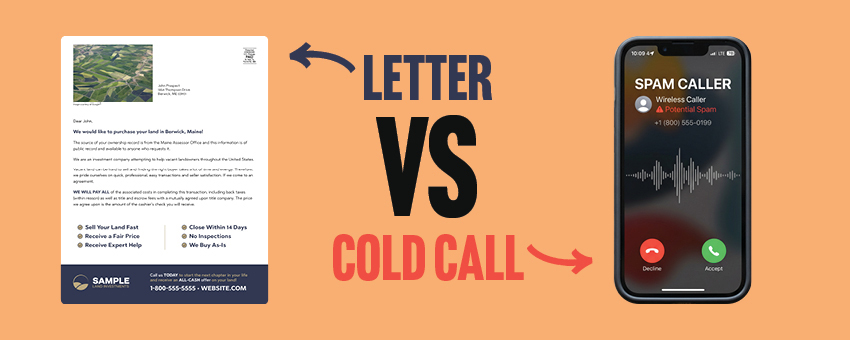
Cold calling lead generation is one of the top marketing tactics in land investing, alongside direct mail. While both have benefits, it’s important to take into account the positives and negatives of each solution.
In this guide, you’ll discover the pros and cons of direct mail and cold calling, as well as how you can effectively create a marketing strategy that delivers real results for your land investment business.
Cold Calling
Cold calling is a common method for connecting with landowners, and it can be an effective practice, but it does have its downsides. These are the pros and cons of b2b cold calling services for land investing.
The Pros:
- Vacant land owners are typically older, so they may prefer to talk to people over the phone, which is a more traditional method of communication for Generation X and Boomers.
- Cold calling is inexpensive and can work for land investors who have ample free time.
The Cons:
- Cold calls have low conversion rates overall and may not deliver the best return on investment. According to a 2012 Keller Center report, only about 1% of answered cold calls converted to appointments, and about 28% of completed calls were considered “productive.”
- For some, cold calls appear somewhat threatening to recipients since they act as interruptions and can lower a business’s credibility, affecting their response on all marketing channels.
- Poorly executed calls can leave a negative impression on the prospect.
- Cold calling is very time-consuming and can get expensive if paid staff are being used to execute calls.
- Depending on who is making the phone calls, there is a chance of employee burnout and frustration from a lack of conversions over time, leading to higher turnover rates.
- It can be difficult for phone calls to get through due to caller ID and phone laws that prevent scams.
- Violations to the Telephone Consumer Protection Act can result in hefty fines and penalties; proceed with caution.
- High Rejection Rates: A significant percentage of cold calls go unanswered or are met with immediate rejection. Some sales professionals report getting 1 lead out of every 100-150 phone calls, with many of those leads still not panning out.
- Time-Consuming: While a well-executed sales call might last around 14.3 minutes, the sheer volume of calls needed to achieve results means a substantial time investment for sales reps.
- Apple’s “Silence Unknown Callers” feature, introduced with iOS 13 in September 2019, and the even more advanced “Call Screening” in the upcoming iOS 26 (announced June 2025), significantly impact cold calling effectiveness.
How call screening works: When an unknown number calls, the iPhone automatically answers silently and prompts the caller to state their name and reason for calling. A live transcription of their response appears on the recipient’s screen, allowing the user to decide whether to answer, send to voicemail, or hang up.
Projected Impact on Cold Calling Success:
- “Connect Rate” Plummet: Some experts predict that for traditional, high-volume cold calling, connect rates could drop by 30-60% overnight for sales teams that don’t adapt.
- AI Gatekeepers: The initial screening is now done by AI, not a human. This means your first 5 seconds are evaluated by AI, not a prospect. If your message isn’t clear, concise, and trustworthy from the start, the call is unlikely to ever reach a human.
- Predictive Dialers Obsolete: Predictive dialers, which connect reps only after a call is answered, will struggle even more. Since they can’t provide the upfront identification Apple’s Call Screening requires, these calls will likely be treated as spam and not connect.
- Increased Spam Label Risk: If your number is flagged as “spam likely” by carriers (AT&T, Verizon, T-Mobile), iOS 26 can effectively block those calls entirely – they won’t even ring, screen, or show up in call logs. This means a 0% connect rate for flagged numbers on iPhones with iOS 26.
- Focus on Verified/Clean Numbers: The emphasis on trustworthy caller ID and STIR/SHAKEN verification (which helps prove a call’s origin) becomes even more critical. If your brand can show up instead of just a number, your chances of getting through the AI filter improve dramatically.
Alternatives to Cold Calling
Direct mail has been a popular form of lead generation for land investors for many years. Its main drawback is the cost, and investors have gone through many rounds of trying to find cheaper alternatives, only to come back to tried-and-true direct mail.
There is a big reason why land investors keep returning to the direct mail method. These are the pros and cons of direct mail marketing.
The Pros:
- Direct mail is a non-intrusive way to reach interested sellers and buyers. They can take their time reading the letter or postcard calmly and casually and decide if they want to respond. Mailers don’t put people on the spot like a cold call does.
Key stat:
54% of consumers appreciate mail because they can keep an interesting piece and refer to it later. - Direct mail has a very high return on investment. Most of the responses that come in are high quality, giving land investors more opportunities for revenue.
Key stats:
Customers acquired through direct mail made 2 purchases on average during the study period, surpassing Google Ads (1.95), Amazon Ads (1.75), and Facebook Ads (1.35).
Average direct mail ROI (161%) exceeds email ROI (44%) by 266%. It also beats digital display ROI (23%), paid social media ROI (21%), and SMS ROI (20%) by 600%, 667%, 705%, respectively.
Direct mail jumped from the 4th or 2nd most influential ad type as ranked by consumers, only behind TV/video streaming. \ - People highly trust printed advertisements, so there is a better chance a prospect will respond to them.
Key stat:
Consumers believe direct mail to be 11% more personal, 17% more likely to catch their attention, and 17% more trustworthy than brand email messages. - A letter or postcard includes pre-printed information that the prospect can digest and take time to investigate and consider, making it a convenient strategy for delivering loads of information all at once.
- You save time fielding only interested sellers and buyers who are taking the time to reach out to you, instead of you reaching out to them.
- Direct mail gives you tons of targeting options so you can reach people who are exactly within your audience parameters.
- There is very little time investment needed on the side of the investor. With a company like RocketPrint and Mail, who handles everything for you, a simple email asking to send another drop of mailers is all an investor needs to do (maybe we can find a quote from a case study related to this?)
The Cons:
- The cost is higher than free methods like cold-calling. However, the ROI supports the cost. See these case studies to get an idea of whether the numbers would work for you.
Direct mail has many important factors that, when done wrong, can sabotage a campaign. The mailing list, the design, the envelope format, and the timing of delivery. If you are trying to do letters yourself, the time investment to learn all of the best practices may be too much. Using a direct mail provider with experience in land investing is usually worth the investment. They also often pass along postage discounts because their mail volume is so high. - Needs to be planned ahead. You’ll need to set up your campaign at least a couple of weeks in advance, so you will need to plan further ahead than you would with a cold calling campaign.
How to generate leads without cold calling
If you want to do less cold calling and launch more direct mail campaigns, the best way to do this is working with an expert and combining mailers with targeted online ads.
Currently, direct mail is the top marketing option for land investors (see 94 published case studies) and with the right vendor can still be budget-friendly. Running a direct mail campaign with coordinated digital ads generates the highest response. Our Everywhere Investing Platinum package includes custom letters with matching online ads on Google, Facebook, Instagram, YouTube, and Gmail as well as behavioral targeting to reach targeted sellers on every channel concurrently.
One of the best features of this marketing plan is the geo-fencing around the mailing address. This means you can now serve online ads to every name on your mailing list.
Since your prospects will receive your mailer as well as see your targeted ads online, they will begin to recognize your business everywhere and think more about calling or emailing you!
If you want to save yourself more time and work with a marketing expert today, let us know and we can get you started.